Jesus Heard SVG, Christian Funny Quote
A Designer’s First Look: Charm with Clear Intent
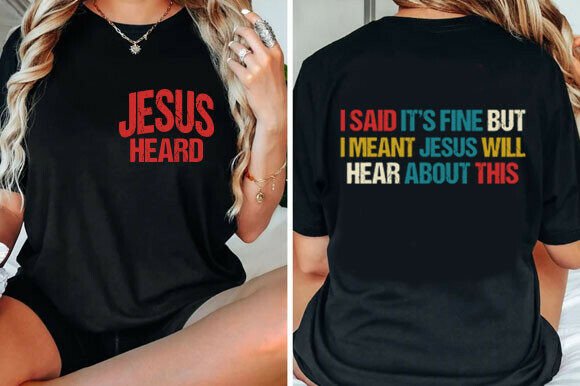
Opening Jesus Heard SVG, Christian Funny Quote feels like flipping to a well-worn page in a lighthearted devotional journal—warm, approachable, and quietly confident. It’s not preachy or ornate; it’s conversational, with clean lettering and a subtle visual rhythm that leans into its humor without tipping into sarcasm. The layout is horizontal, compact but breathable—no cramped spacing, no fragile serifs. That tells me right away this isn’t just a T-Shirt Designs download for screen printing—it’s built with embroidery in mind. The phrase “Jesus Heard” sits front and center, followed by the punchline “...and He’s still laughing.” The ellipsis and lowercase “he’s” add personality, while the punctuation stays legible at stitchable sizes.
Real-World Test: A Custom Embroidered Tote for a Church Boutique
Last week, I prepped this design for a small-batch run of canvas tote bags destined for a local church’s spring bazaar. Not mass production—just 24 pieces, stitched on mid-weight natural cotton canvas with a tear-away + cut-away stabilizer combo. I chose soft heather gray thread on off-white fabric, and the result landed exactly where I hoped: friendly, faith-centered, and unmistakably handmade. Customers paused—not because it was flashy, but because it felt *true*. One woman bought two: one for herself, one for her teen daughter who’d just started youth group. That kind of quiet resonance? That’s the hallmark of a design that works beyond decoration.
Where It Shines (and Where It Asks for Care)
Jesus Heard SVG, Christian Funny Quote excels on stable, medium-weight fabrics where stitch definition matters: sweatshirt embroidery, pillow covers, tea towels, and structured aprons. Its moderate width and open letter spacing hold up beautifully on curved surfaces like baseball caps—if you use a cap frame and reduce density slightly near the curve’s apex. On baby embroidery projects (think organic cotton onesies), it reads clearly even at 3.5" wide, especially when paired with gentle pastel threads and lightweight stabilizer.
But here’s where attention matters: avoid pushing it onto thin or highly stretchy fabrics like jersey knits without significant digitizing tweaks—those delicate apostrophes and low-contrast internal curves can blur or skip during stitching. Dark fabric? Yes—but only if you confirm thread color contrast holds up in your actual embroidery file preview. And never skip the test stitch on scrap fabric first: what looks crisp in vector form may need slight kerning adjustment or reduced fill stitch density to prevent puckering on dense cotton twill or textured linen blends.
Stitch Behavior & Visual Trust
This isn’t a high-density applique design—it relies mostly on satin stitch outlines and clean fill stitch areas, which means faster sew-outs and less thread breakage on home machines. That’s a real win for Etsy sellers juggling custom orders alongside family life. Visually, it avoids over-decoration: no halos, no drop shadows, no distracting flourishes. That restraint builds trust. When customers see this on a finished product—a personalized gift, a boutique sweatshirt, a holiday embroidered blanket—they read sincerity, not clutter.
It also scales thoughtfully. At 4" wide, the text remains legible on a tote bag handle strap. At 2.75", it anchors a baby bib without overwhelming. That flexibility makes it strong design assets for craft business owners building cohesive collections—pair it with simple cross motifs or olive branch borders, and you’ve got a recognizable brand voice across multiple product types.
Practical Notes Every Embroidery Designer Should Run Through
- Test before committing: Stitch on your exact fabric + stabilizer combo—not just a generic scrap.
- Check thread color contrast: Try black, navy, and charcoal on light backgrounds; cream or light gray on darks. Avoid yellow-on-cream unless your machine handles fine detail flawlessly.
- Review stitch density: If your machine hesitates or fabric puckers, reduce fill stitch density by 10–15% in the software before saving your final embroidery file.
- Confirm hoop size fit: Measure the design’s widest point against your standard hoop—this one fits comfortably in a 4x4, but push to 5x7 only if your stabilizer and fabric support it.
- Inspect tiny details: Zoom in on the apostrophe in “He’s” and the dot in “i”—are they fully digitized as running stitches or implied gaps? If unsure, edit or contact the seller.
- Mock it both ways: Generate printable mockups in black-and-white and full color to gauge readability across lighting conditions and customer expectations.
- Verify licensing: Before listing finished products on Etsy or bundling this as part of a digital embroidery bundle, confirm whether commercial use is permitted—and whether attribution is required.
Fitting Into Real Creative Workflows
For small shop owners and handmade product makers, Jesus Heard SVG, Christian Funny Quote fills a specific, valuable gap: joyful faith expression without cliché. It’s not for every project—but when it’s right, it’s deeply right. I’ve used it on kitchen towels for a pastor’s retirement gift, on denim patches for a youth group fundraiser, and as a subtle chest embroidery on unisex crewnecks for a nonprofit’s volunteer appreciation day. Each time, it elevated the item from “nice” to “meaningful,” without demanding explanation.
That’s the quiet power of well-considered Christian embroidery design: it doesn’t shout doctrine—it invites connection. And for designers, sellers, and makers who value clarity, craftsmanship, and emotional resonance over trend-chasing, this one earns repeat use. Just remember: treat it like any serious embroidery project—test, adjust, stabilize, and stitch with intention.